At a time when both functions have never been more important or widely used, security and audio visual systems are increasingly being integrated together to optimize performance, productivity, and cost-efficiency, among other advantages. Here’s what leaders should know about the benefits of AV-security integration, and how it can improve the capabilities of both.
- Seeking integrated security or audio visual solutions? Contact the experts here
What is Audio Visual-Security Integration?
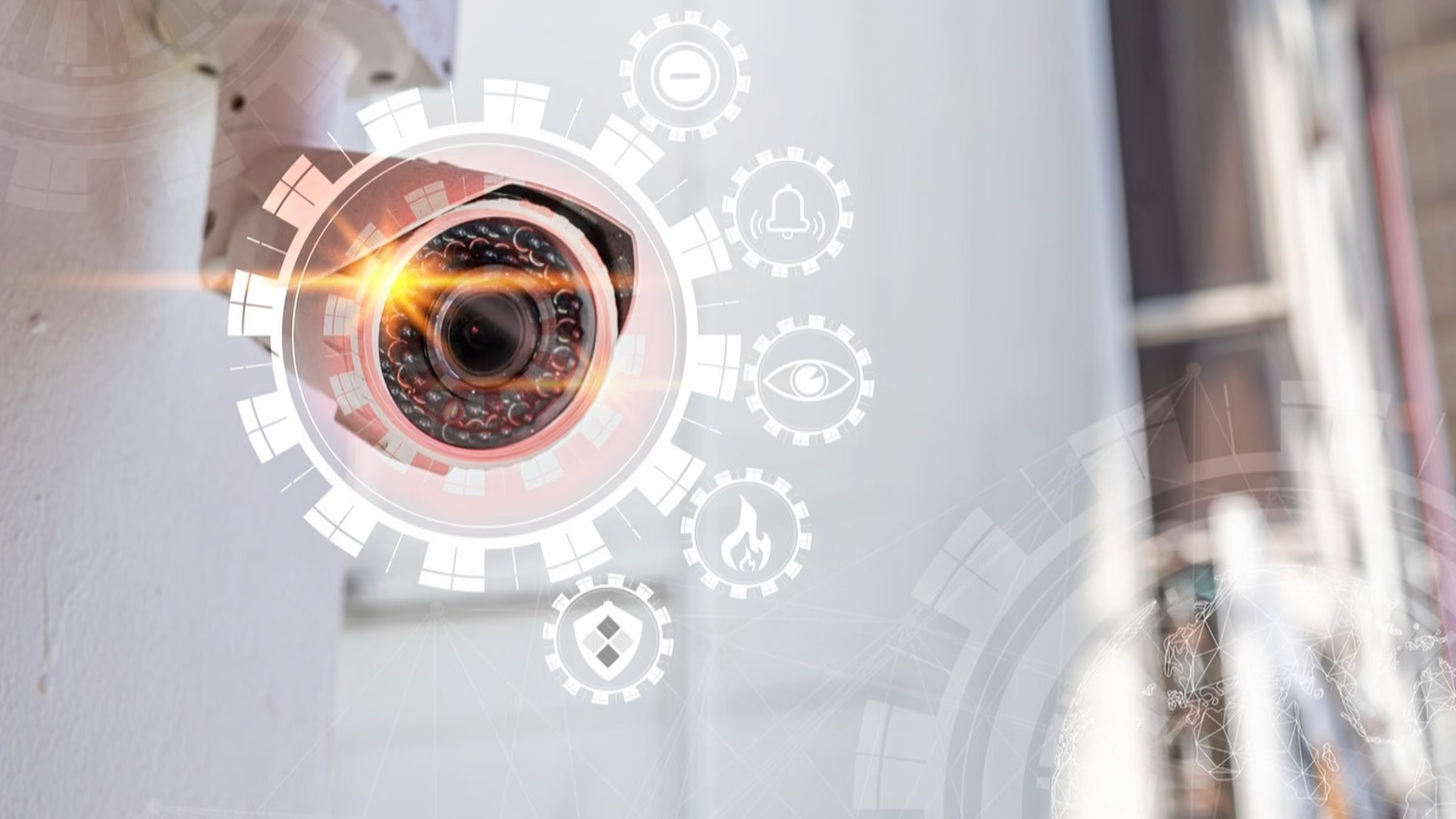
Just as it sounds, integrating audio visual and security means utilizing a shared infrastructure to combine these two essential functions into one centrally managed system. But because it offers the potential to greatly enhance both, it’s also much more than a simple integration, delivering benefits that far exceed the sum of its two individual parts.
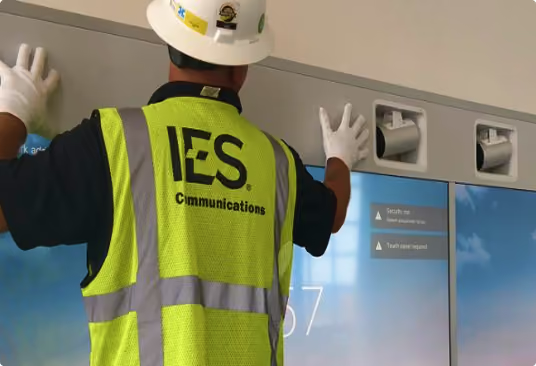
In practical terms, this convergence gives security teams access to AV components like digital video wall displays, high-quality cameras, and high-definition audio systems that can be used to improve oversight, responsiveness, and efficiency. By the same token, integration provides a higher level of protection to AV systems.
But beyond the practical sharing of essential components, this process also infuses security with higher-functioning technology that can help achieve longstanding goals around AI and Internet of Things (IoT) investments and initiatives. At the same time, it’s a force-multiplier when it comes to boosting the interconnectedness, reach, and power of Security Operation Centers (SOCs).
And that’s just the start. Let’s take a closer look at how AV-security integration works, the benefits it offers, and what leaders should consider before choosing a solutions provider.
How Security Integration Benefits AV Systems
At a time when the use of audio visual technology is rapidly expanding — and increasingly integrated with other essential IT infrastructure via AVoIP functionality — the need to protect AV systems at a higher level has become mission critical. And that’s especially true with the integration of new tech like AI, and as availability spreads to more devices and more places.
Integrated AV-security systems help meet this goal in a few key ways. For instance, it can:
- Enable advanced motion tracking and/or facial detection features in security cameras to be utilized for AV system control features, with the ability to restrict AV functionality based on access permissions and or time schedules
- Enable credential data to be utilized to trigger custom AV features for specific users, including automatic room activation upon badge access or displaying relevant camera feeds when a door is forced open or access violations occur
- Provide personalized and secure room experiences like the ability to load custom lighting, display layouts, and/or audio settings based on credential holder identity
- Enable custom visitor and training room workflows like the ability to launch welcome messaging, digital signage, or presentation content when attendees arrive
How AV Integration Benefits Security
Integrating these two essential functions may provide an even bigger advantage to security systems. At a time when many organizations are actively working towards integrated and/or unified security, adding AV functionality into the mix can:
- Enhance surveillance capabilities with real-time visibility across an organization’s entire space, which can provide a higher level of networked monitoring that’s enhanced with tools like AI-powered facial recognition, thermal imaging detection, and cameras with high definition to improve picture quality or wide-angle lenses to eliminate blind spots
- Improve risk detection with instant data sharing, plus AI-powered analytics that can detect abnormal patterns in movement and behavior and quickly make sense of a huge amount of data for a higher level of assessment and responsiveness than what’s possible with manual oversight
- Achieve instant, real-time communication and coordination among security teams with easier access to tools like videoconferencing, PA and intercom systems, and audio broadcasting, including IoT integration for handheld devices
- Infuse security within the culture and improve overall preparedness and responsiveness with instant, reliable delivery of security and emergency messaging via digital signage and PA systems — both in targeted zones and across the organization — thus helping eliminate confusion during incidents while supporting everyday readiness among staff
- Enable flexibility and scalability to accommodate operational growth and system upgrades, so that new functions and emerging technologies can be easily incorporated when and where they’re needed, from quickly adding and upgrading video screens in different rooms to incorporating new buildings into the larger security apparatus
- Provide a higher level of centralized control with interconnected security operation centers (SOCs) that integrate all data points within a single hub in real-time, complete with advanced digital displays that provide instant assessments, data mapping, and other visualizations that drive situational awareness and more informed decision-making
This is just the beginning, too — especially when powered by higher-performing AVoIP systems, these functions can expand in almost limitless directions. For instance, data points from separate locations like data centers and colo facilities can be instantly integrated, and command centers can be more easily expanded into global SOCs (GSOCs) to manage operations across multiple facilities in different cities, states, countries, or even hemispheres.
How to Seize the Benefits of Audio Visual-Security System Integration
If you’ve never before considered the possibilities of AV-security integration, you’re not alone. As an emerging function, it’s also a specialized model that many providers of siloed AV and security systems can’t yet achieve. And given its importance — and need for precise design-build expertise — it’s also a process that shouldn’t be spread out among multiple vendors.
In other words, AV-security integration isn’t a standard offering for many standalone providers, offered only from a select handful of specialists. But all the same, given the wide range of benefits it offers, it’s a solution that’s quickly becoming essential, especially as AI is being used to create security vulnerabilities within mission-critical systems in quickly evolving ways.
And, while a handful of providers offering full AV-security integration have emerged in recent years, leaders should be careful when choosing one. At a glance — and at a minimum — a partner should offer a long history of expertise in both fields, as well as expertise following industry standards for cabling, cloud networks, and IoT. They should also be able to advise (and deliver) on AVoIP best practices like leading protocols and IMPX standards.
Need Guidance on AV-Security System Integration?
If you’re interested in leveraging the power of integrated AV-security systems for your organization, you’ve come to the right place! As a leading provider of both functions, IES Communications is a pioneer in successfully and effectively integrating audio visual functionality with integrated security systems. Contact us today to learn more.