What standards apply to the cabling that connects data and telecommunications systems, both in data centers and other commercial buildings? Here’s a rough guide to the most important structured cabling standards, why they matter, and how businesses and other organizations can make sure they’re following them.
- Need help with structured cabling? Contact the experts here
Quick Guide to Structured Cabling Standards
A system for organizing and managing the cabling infrastructure that connects data, communications, video streams, building management systems, and more, structured cabling has become an operational necessity for most businesses and organizations operating today.
And it’s not hard to understand why. With a whopping 96 in every 100 companies estimated to experience a network outage every quarter — at an estimated cost of $4,344 per minute — structured cabling helps ensure network uptime when that’s never mattered more.
Just as importantly, structured cabling helps prevent network degradation, or the decline in performance that comes from interference, congestion, equipment malfunctions, and other common issues. And it does so while making network management and new user integration easier and more cost effective, among other operational benefits.
- Learn more about the basics of structured cabling here
What Are Structured Cabling Standards?
From layout and installation to performance and testing, there are a number of specific standards that regulate those structured cabling systems. First created in the 1980s out of a basic need to standardize the growing use of wiring and cabling in telecommunications infrastructure, these evolving standards have shaped the development of structured cabling best practices ever since.
Unlike the traditional, ad-hoc setups of yesterday — cluttered, tangled, and often unsafe — today’s structured cabling standards help ensure that all systems are organized and more efficiently managed, dramatically improving performance and uptime while giving leaders a new level of control over data speed, bandwidth, and latency in the facilities they manage.
The Benefits of Following Structured Cabling Standards
Essential for any successful structured cabling installation, understanding and following structured cabling standards can also help organizations:
- Avoid interference, spotty transmission, lag, and data loss
- More easily and cost-effectively accommodate increasingly complex cable setups and installations
- Comply with safety standards around preventing fire, water damage, and other hazards
- More easily and cost-effectively upgrade to newer equipment or add new users
- Streamline oversight and system diagnostics to improve maintenance and avoid cost overruns
- Achieve interoperability and backwards-compatibility for a more versatile network
- More proactively plan and design systems to accommodate future growth and expansion
Who Creates Structured Cabling Standards?
Cabling standards are determined and published by a range of organizations based both in the United States and abroad. The primary organizations deciding structured cabling standards are:
- The Telecommunications Industry Association (TIA)
- The American National Standards Institute (ANSI)
- The International Organization for Standardization (ISO)
- The International Electrotechnical Commission (IEC)
- The Institute of Electrical and Electronics Engineers (IEEE)
Types of Structured Cabling Standards
In North America, structured cabling is primarily governed by the ANSI/TIA-568 Series, 569-E, 606-D, and 607-E standards, which collectively define cabling performance, pathways and spaces, administration, and grounding and bonding requirements.
- The ANSI/TIA-568 series (originally TIA/EIA-568) is a set of six individually published standards for the various cabling types and components used in commercial buildings in the U.S. and North America that includes:
- ANSI/TIA-569-E defines the standards for the design and installation of Telecommunication pathways and spaces such as conduits, cable trays, j-hooks, equipment rooms (ER) and telecommunication rooms (TR)
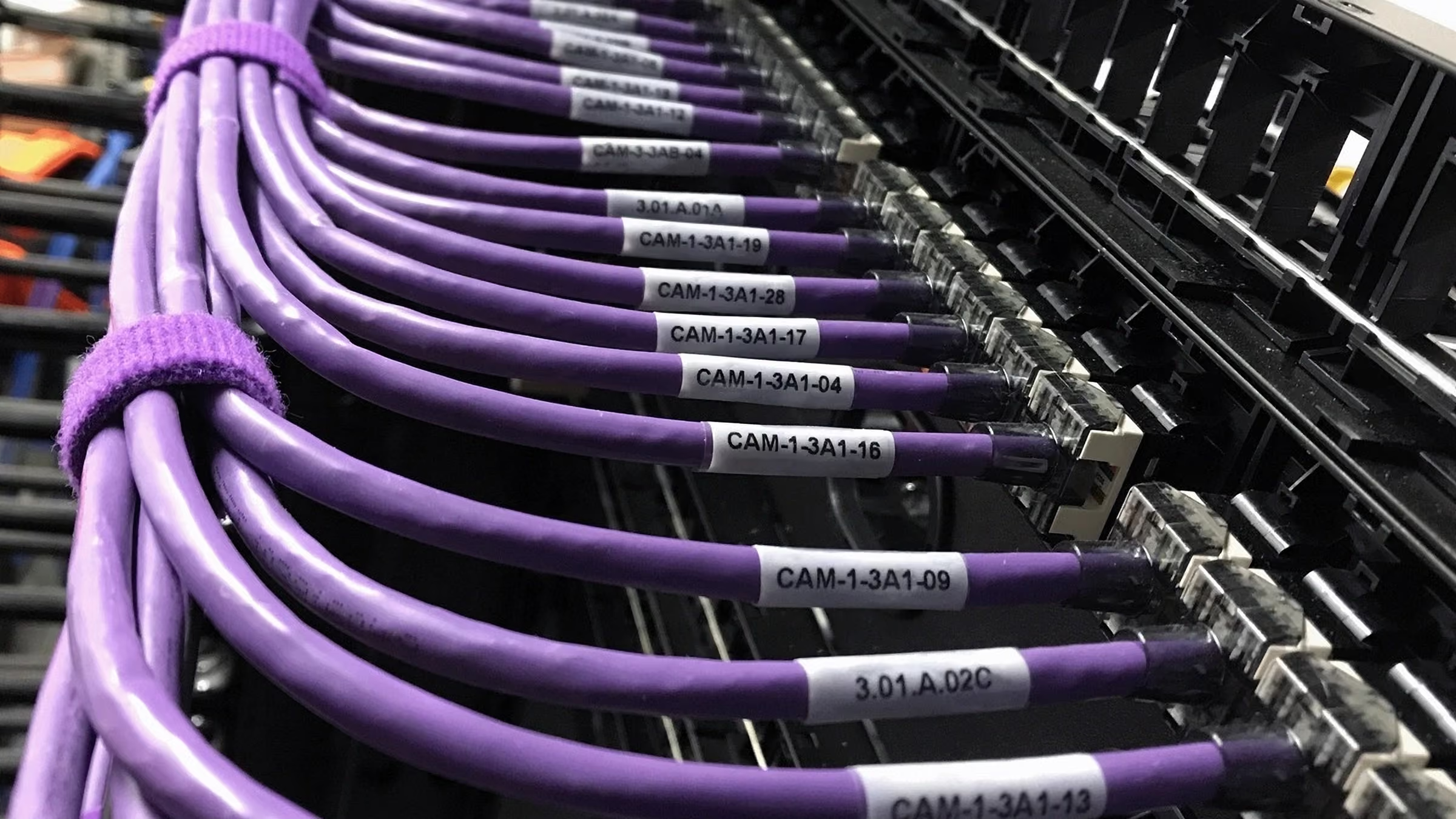
- ANSI/TIA-606-D, the administration standard for telecommunication infrastructure, defines proper labeling and record documentation of a system
- ANSI/TIA-607-E establishes the standards for bonding and grounding of telecommunication systems.
- ISO/IEC 11801 provides international standards for telecommunications cabling in commercial buildings
- IEEE 802.3 provides international standards for Ethernet networks, emphasizing criteria like data transmission speeds and signaling methods over physical media (i.e., copper and fiber cable)
What Are the Standards for Ethernet Cabling?
The structured cabling standards outlined above also include categories for Ethernet cables:
- ISO/IEC Class D (ANSI/TIA Cat5e): up to 1 Gbps (speed) and 100 MHz (bandwidth)
- ISO/IEC Class E (ANSI/TIA Cat6) up to 10 Gbps (speed) and 250 MHz (bandwidth)
- ISO/IEC Class Ea (ANSI/TIA Cat6a, or Augmented Category 6) up to 10 Gbps (speed) and 500 MHz (bandwidth) at distances of up to 100 meters
- ISO/IEC Class F: up to 10 Gbps (speed) and 600 MHz (bandwidth) at 100 meters, with shielded cable design (sometimes referred to as Cat7 but not officially recognized by ANSI/TIA)
- ANSI/TIA Cat8: up to 40 Gbps at 30 meters, with shielded cable design
For the most part, Cat5e, Cat6, and Cat6a are more often used in office buildings, while the more powerful and highly shielded Class F and Cat8 categories apply more to data centers and other higher-demand (or interference-prone) environments.
Structured Cabling Standards for Data Centers
When it comes to data centers, meeting structured cabling standards is perhaps even more important. With the entirety of a data center’s operational output depending on its cabling foundation, following set standards helps ensure uptime, scalability, and optimum data transmission in a way that can directly — and significantly — impact an organization’s bottom line.
In addition to ANSI/TIA-568, ISO/IEC 11801, and IEEE 802.3, data center cabling standards also include:
- ANSI/TIA-942-C applies the ANSI/ITA-568 to the specific setting of data centers, including layout, space management, and data performance
- BICSI offers certifications around data center design, installation, and management
Get Expert Help with Structured Cabling Standards
Overwhelmed? We know structured cabling standards can be a lot to understand. And as always, we’re here to help with customized solutions that best meet your operational needs while ensuring compliance. Take advantage of our decades of structured cabling experience: Contact us today to see what our team of certified experts can do for your organization.