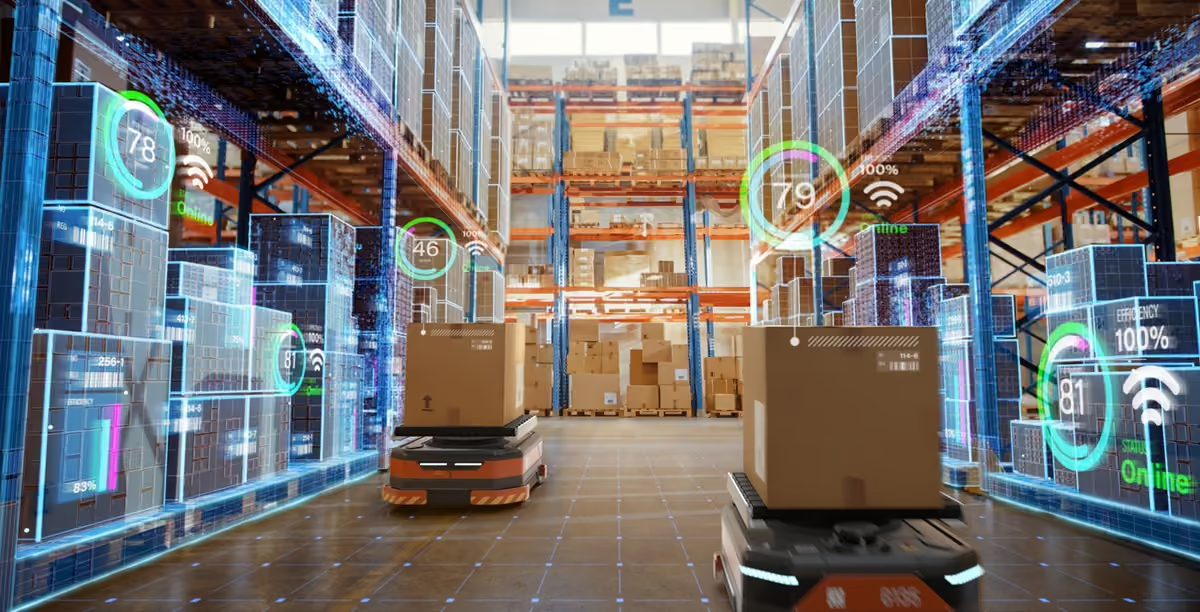
Adaptive robotics is reshaping manufacturing, logistics, and healthcare, among other industries. But supporting these deployments means building advanced networks and edge computing infrastructure. Here’s what it takes to build a robotics-ready foundation and prepare for what’s next.
- Ready to build a robotics-ready edge infrastructure? Contact us here
Key Takeaways: Building a Robotics-Ready Infrastructure
- The use of adaptive, AI-driven robotics has become an essential part of industries like construction, manufacturing, healthcare, research, and distribution, where it’s already having a transformative effect on efficiency, output, and safety.
- But because any robotics deployment is only as strong as the infrastructure that supports it, achieving robotics-readiness means building (or upgrading) core technological capabilities to enable edge computing.
- At minimum, the capabilities required by a robotics-ready edge infrastructure include machine vision; fully secure compute and processing; localized edge AI inference; and continuous, low-latency, non-cloud connectivity.
Is Your Business Ready for Adaptive Robotics?
For many businesses, the use of adaptive, AI-driven robotics technology is more than a practical consideration — it’s an urgent necessity. It’s certainly the future in any industry where automation has a transformative effect on output, efficiency, or safety — for instance, construction, manufacturing, and distribution, to name just a few.
In fact, adaptive robotics has arguably created a tipping point for those asset-intensive, high-stakes industries. It’s already changed what it means to be competitive and future-ready. And, as more and more companies leverage AI-driven robotics to drive efficiency and increase their marketplace value, others must follow or risk being left behind.
Yet robotics-readiness takes more than initiative. It requires a forward-looking approach that includes a plan for building (or upgrading) the necessary infrastructure well in advance, a clear understanding of what’s required, and the right partner to help put it all together.
The Future is Here: Industries Where Adaptive Robotics is a Reality
First of all, when we talk about adaptive robotics, we’re talking about an advanced technology that carries out complex functions with precision and efficiency, unlike the traditional, static robotics of the past. The goal is to perform repetitive, labor-intensive, even dangerous tasks that only humans could do previously, and in the process, dramatically improve operational efficiency and capabilities.
As companies face growing pressure to maximize productivity and quality while reducing operational costs, adaptive robotics has emerged as a powerful tool for achieving these goals and more. Using a combination of AI, machine vision, and other edge computing capabilities, the leaders in adopting adaptive robotics aren’t just driving performance improvements but transforming what’s possible. Let’s take a look at some of the most innovative examples.
Adaptive Robotics in Research
In biotech and pharmaceutical research laboratories, robotics is being used to perform repetitive and often dangerous tasks like handling, transporting, and transferring liquids, cell cultures, and other samples. It’s also improving the precision and reliability of those tasks, as well as high-throughput screening (HTS), which enables the rapid testing of a high volume of samples — a critical component in early-stage drug research.
Adaptive Robotics in Construction
Unlike traditional solutions of the past, adaptive robotics has proven effective at carrying out repetitive and dangerous tasks like welding, concrete pouring, bricklaying, and transporting heavy and hazardous materials. This can reduce employee exposure while improving safety, precision, and speed.
In addition, robots equipped with 3D scanners, thermal detection, and teleoperation capabilities are also performing automated site inspections, including virtual jobsite walks, especially in rough terrain and remote areas. This provides real-time data, leverages workforce expertise more efficiently, and can help reduce workplace injuries.
Adaptive Robotics in Healthcare
In healthcare, the use of AI-powered surgical robotics is already widespread, and has been proven effective in reducing complications, operating times, and costs, while improving precision, workflow efficiency, and patient recovery times — and all by double-digit margins. It’s also automating repetitive lab tasks, assisting in physical therapy, and even fulfilling social functions or caregiving support.
Adaptive Robotics in Manufacturing
Especially in high-stakes sectors like defense, aerospace, and automotive manufacturing — where errors and inefficiencies are both prevalent and costly — AI-driven robotics is enabling low-touch, soft component assembly, pressurized-valve manipulation, wire-harness and multimodal tactile insertion, and other high-precision functions, helping reduce errors, scrap rates, and rework.
Adaptive Robotics in Warehousing
Distribution and fulfillment centers may very well be putting adaptive robotics technology to its most advanced stage of use. In just the last few years, for instance, Amazon has introduced new capabilities that have raised industry expectations.
Order processing, product picking and sorting, and the storage and retrieval of goods via automated storage and retrieval systems (AS/RS), automated guided vehicles (AGVs), and automated guided carts (AGCs) are now widespread. And AI-driven automation has also extended automation to packing, re-packaging, and distribution to customers — all while providing continuous, real-time updates to inventory management software and systems.
Why Adaptive Robotics Requires Edge Infrastructure
These industries have all experimented with traditional robotics in the past, with varying levels of success. But adaptive robotics is truly a game changer, delivering on its promise to reliably and efficiently automate labor-intensive, error-prone, and high-risk manual tasks — and in a way that drives real performance improvements and cost savings.
And that’s thanks to advancements not just in robotics, but a suite of other technologies that power its underlying infrastructure. After all, adaptive robotics isn’t an isolated tool but a complex system of interlocking and often interdependent functionalities — everything from local AI processing, wireless connectivity, fiber backbones, security segmentation, and reliable network operations.
Collectively called edge computing, these functions are all necessary to process the massive amounts of data that robotics produce, collect, and require to work. To deliver advanced, high-performing capabilities at the source, rather than in the remote cloud or distant data center, companies leverage infrastructure partners who deliver and optimize dependable, low-latency environments.
5 Essential Components of an Edge Infrastructure
1: Machine Vision
A more advanced form of computer vision, machine vision is a term that encompasses the hardware needed to capture and process visual data — think high-resolution cameras and lenses and LED light sources — as well as the software needed to process and interpret that data. Together, these technologies enable highly detailed, automated image-based inspections.
2: Continuous Connectivity
Adaptive robotic systems need constant connectivity to perform mission-critical functions where downtime is not an option. In other words, they can’t stop operating because of a loss of connectivity — this is achieved by removing Wi-Fi reliance (or augmenting it) with solutions like in-building wireless, private cellular, or CBRS rather than cloud-based systems.
3: Edge AI Inference
In addition to communications connectivity, the data source for adaptive robotics must be localized, too. Also known as edge AI inference, localized connectivity moves dataset access to local devices rather than the cloud or a remote server, enabling real-time data analysis, decision-making, and machine learning, even when a system is essentially offline.
4: Secure Compute & Processing
Security is another major reason to bypass the cloud and keep connections local. Because the transmissions that power adaptive robotics are rich with sensitive and proprietary data, the use of external connections presents an unacceptable level of exposure and risk (and potential regulatory liability). Edge computing ensures your confidential data never leaves the premises.
5: Low-Latency Connectivity
Finally, connectivity must deliver the lowest practical latency to reduce sensor-to-action delays and support immediate, precise interactions. Local infrastructure helps ensure this by reducing round-trip network delays and delivering the immediate response required for autonomous, AI-driven robotics.
How to Create an Edge Infrastructure Strategy
The short version? A robotics deployment is only as strong as the infrastructure that supports it.
Businesses planning to harness this transformative technology must begin building the underlying infrastructure now. In most cases, this means deploying essential edge computing components on-site, including independent AI cores and clusters, wireless systems, including CBRS, localized server rooms similar to those used before the cloud era, and other technologies needed to support their long-term vision.
And as adaptable robotics becomes more advanced, intelligent, and mobile, the demands of the infrastructure required to power it will continue to grow, too. And that means businesses must prioritize scalability and work with a partner who can deliver the long-term support needed for today, tomorrow, and whatever the future holds.
Build the Infrastructure You Need for Adaptive Robotics
So, is your business ready for the robotics revolution? Do you have the infrastructure you’ll need to compete? Contact the experts at IES Communications today to discover what robotics readiness really means, and how we can help you get there.